

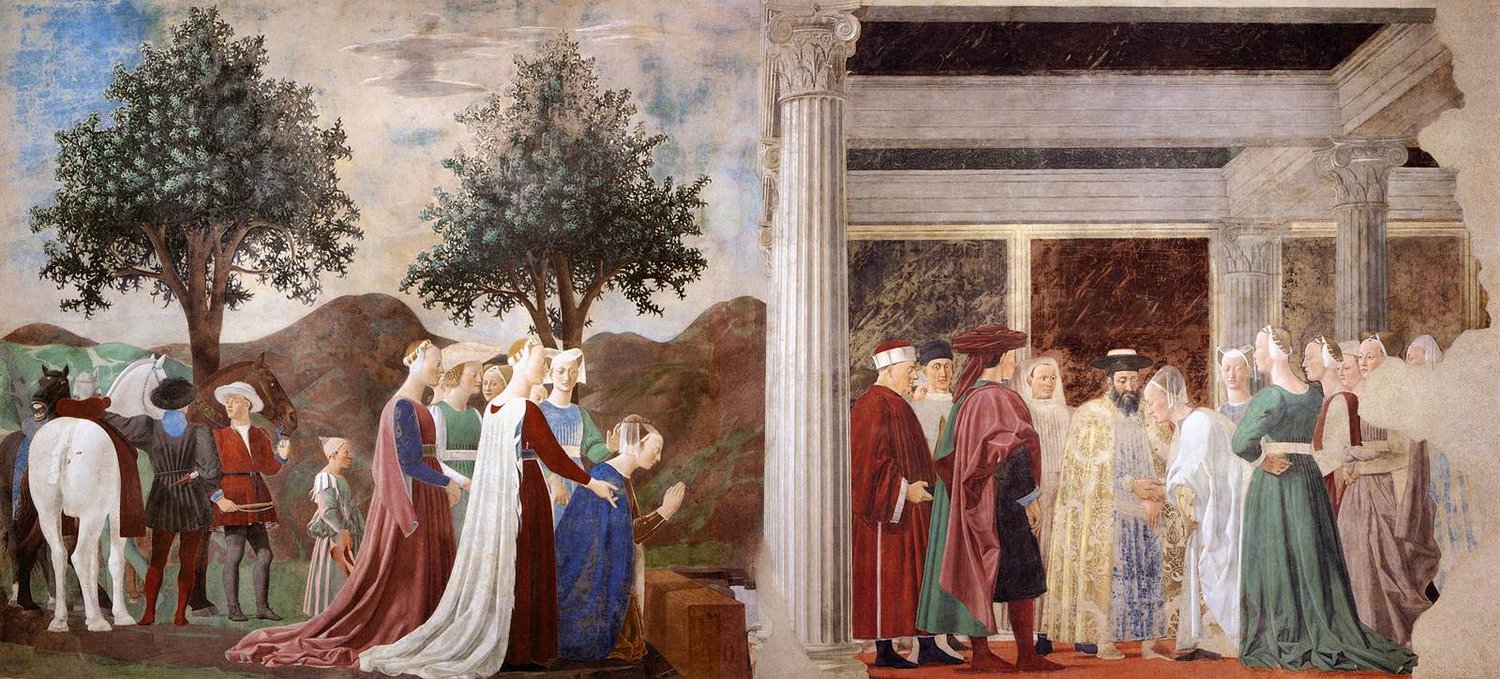
Happy New Year!
I hope you are still enjoying Christmas, whether you are keeping the full twelve days and celebrating the second Sunday of Christmas this week, or cutting it short and transferring the Epiphany to this Sunday.
Either way, I’ve got you covered as there are psalms for both in the shop! (Click here for Christmas 2)
However, this post would be a bit congested if I were to discuss both translations here, so I’m going to focus on the Epiphany Psalm: Psalm 72.10-15.
The first challenge here is how to translate the places mentioned in verse 10 as Tarshish, Sheba and Seba are not on our maps today.
Firstly, where was Tarshish?
In both Kings and Chronicles, we learn that every three years ships of Tarshish (often translated as trading ships) brought luxury goods including gold, silver, ivory, apes and peacocks to King Solomon (1 Kings 10.23, 2 Chronicles 9.21) and in Ezekiel we learn that iron, tin and lead also came from there (Ezekiel 27.12). From this we can deduce that it was at a great trading nation (or perhaps city) at a great distance from Israel (otherwise the ships would probably arrive more frequently). It is also the far-distant place that Jonah bought a ticket for when he fled God when God told him to go to Nineveh!
There has been a great deal of speculation as to where it was, including Spain, Sardinia, Carthage, Southeast Africa, Southern India and even (according to some 19th century commentators) Cornwall.[1]
While it seems most likely that it was a place on the Mediterranean a long way from Israel, the location of Tarshish is lost to us today. So I have not attempted to translate this place name.
Having made that decision it would be inconsistent to translate Sheba and Saba, although these probably refer to a kingdom in Southern Arabia where Yemen is now. Indeed, the Septuagint has Arabia instead of Sheba.
In verse 11, the original has all kings bowing down and nations serving ‘him’. I have chosen to expand the pronouns and render them as ‘the Lord’ and ‘our King’. Looking at the psalm as a whole, it is clear that the referent is the king addressed at the start of the psalm (probably Solomon). For this text to work independently, we need to make the referent explicit and it seems fitting on the feast of the Epiphany it should be possible to infer that Jesus is our Lord and King.
10 The kings of Tarshish and the isles will pay tribute.
The kings of Sheba and Seba will bring gifts.
11 All kings will bow down before the Lord,
All nations will serve our King.
In verse 12 the Septuagint (LXX) differs from the Masoretic text. (I believe that it is important to pay attention to the Septuagint as this is the version of the Hebrew Bible that the Gospel writers tend to quote from.) LXX has ‘delivers the powerless from the hand of the mighty’ while the Hebrew has ‘delivers the needy when they call for help’ and then adds ‘the poor who have no helper’.
In deciding how to render this verse, I considered using the LXX interpretation but ultimately decided to stick with the parallelism of the Hebrew text as the helpless are rescued from violence and oppression in verse 14.
This gives the second stanza a unified theme of the Lord rescuing the poor and needy (and again, I have supplied a referent for the pronoun ‘he’.)
12 For the Lord rescues the needy when they call
and the poor who have none to help them.
13 The Lord has compassion on the poor and needy,
saving the lives of the helpless.
In verse 14, I have again made the referent explicit as the refrain has come since ‘the helpless’ (to whom this verse clearly refers) were mentioned at the end of the previous stanza. Many translations have ‘their blood will be precious in his sight’ but I have rendered this in more natural English as ‘viewing his blood as precious’.
Verse 15 was a tricky verse to translate. Many translations have ‘and he shall live’ or ‘long may he live’. I find this problematic as it isn’t clear who is being referred to, especially as ‘the Lord’ is likely to be interpreted as God in verse 14.
While we may be interpreting the Lord as Jesus, and Jesus is King, I think it is helpful to be explicit that it is the king who lives forever rather than the Lord God (who is eternal and doesn’t need wishing a long life at that would imply an eventual demise). Using the traditional acclamation ‘Long live the king!’ seems appropriate, and is indeed the solution also favoured by the New Living Translation (and the NIV is similar, but with a pronoun).
14 The Lord rescues the helpless from violence and oppression,
viewing their blood as precious.
15 Long live the king! May gold from Sheba be given him.
May he be prayed for continually and blessed all day long.
Follow this link to the music for this psalm and I will be adding the rest of the psalms from Epiphany to Candlemas as soon as possible.
[1] See https://en.wikipedia.org/wiki/Tarshish