

This week the whole of psalm 65 may be sung, or you can begin at verse 8 (CW numbering, 9 in Bible numbering!). I have translated the whole psalm as it will be needed again later in the year. It should be noted that, in places, this translation is even freer than usual!
The psalm is headed ‘To the director of music, a psalm. Song of David.’
1 O God, praise awaits you in Zion;
we will keep our promise to you.
2 All people will come to the God who answers prayer.
Wicked words have won against me, but you forgive our sins.
A more literal translation of the second line of verse 1 is, ‘the vow to you will be performed’ (and the Septuagint adds, ‘in Jerusalem’). I have chosen to use ‘promise’ instead of ‘vow’ as that is more everyday language. From that follows the verb ‘to keep’, as one keeps promises.
Most Bibles keep this in the passive and put it into an English future tense. The CSB is concise, using, ‘vows to you will be fulfilled’ while the NLT and NIV make it clear who is fulfilling the vows: ‘We will fulfil our vows to you’ (NLT) ‘to you our vows will be fulfilled’ (NIV). As it is clear that the psalmist is referring to their community, I decided to follow suit and use ‘we will keep our promise to you’.
In verse 2, my initial draft of the first line was ‘You who hears prayer, to you shall all creatures come’, ‘creatures’ being an interpretation of ‘all flesh’ that I have used before. On reflection, I decided to change this as most creatures don’t pray (as far as we know!), so this probably refers to people. (Which is what the NIV uses). As not all people have yet come to God, and the Hebrew imperfect denotes an unfinished action, I decided to put this in the future tense. This still needed reordering for it to flow well in English, and my next version was, ‘All people shall come to you, who hears prayer’. In the Hebrew the verb ‘to hear’ is an active participle that acts as an adjective describing God as one who hears. According to the lexicons, it can also mean ‘to grant a request’, which seems an appropriate interpretation, so it became ‘the God who answers prayer.’
The second line of verse 2 also required some thought. My initial ideas were:
Guilty/iniquitous words/speech/deeds have prevailed against me
our transgressions/rebellion/sin you will cover over/make atonement for/cancel/cleanse/pardon.
To unpick this and make appropriate choices, I needed to think about what the whole phrase means. To do this, I considered the following points:
- The verb drafted as ‘have prevailed’ is in the perfect tense (a finished action)
- The Hebrew noun dabar can mean ‘word’ or ‘thing’ (but some sort of speech or utterance seems to be the primary meaning)
- The noun avown means ‘iniquity’ (or ‘guilt’ or ‘punishment’ but these seem less likely here).
So the general sense of the whole phrase could be something like ‘Lies have won’ but this would be difficult to use because these are directed ‘against me’.
Next I looked at alternatives to ‘iniquity’. This could be rendered as ‘wickedness’, ‘sin’ or ‘evil’ so, ‘wicked words’ or ‘evil deeds’ are both possible translations (sin doesn’t work so well with an adjective). I quite like the alliteration of the first option, so I went with that.
The next issue was what to do about ‘prevail’, which is not an everyday word. Its synonyms include ‘win’, ‘triumph’ and ‘overcome’ and the Hebrew tense is perfect (completed action). I was tempted to put ‘wicked words have won’ but the Hebrew has ‘against me’ and ‘won against me’ sounds weird. I also considered ‘purge our sins’ but ‘pardon’ or ‘forgive’ work better in modern English (even if they are less forceful). Next, I considered ‘you will pardon our sins’. The tense is imperfect, so it could be a future or present in English but I decided to simplify it and use the present with the verb ‘forgive’.
(After that lengthy discussion of the first stanza, you will be relieved to hear that there is less to say about the rest of the psalm!)
3 Those you choose to bring near shall be blest,
they will live in your courts.
We will enjoy the bounty of your house,
the holiness of your temple.
After noting a range of possible translations for words in verse 3, my draft of the first line was, ‘Happy are the chosen you have brought near’. This is rather awkward, so I simplified it to ‘Those you have chosen and brought near’ and then realised that the Hebrew tense is imperfect and put it into the present tense. In line 2, I decided to use ‘courts’, as the temple is mentioned at the end of the stanza, so the meaning is clear.
In line 3, the Hebrew verb is given in the lexicons as ‘to be satisfied with’ or ‘to take one’s fill’. I think the general sense is therefore one of ‘enjoy’, as in ‘to have the benefit of’[1]
4 O God our saviour, you will answer us justly.
You are the hope of the ends of the earth and distant seas.
5 Your power built the mountains,
for you are armed with strength.
In verse 4, I decided to follow the LXX and use ‘O God our saviour’ (like the NIV) and to put it at the start of the verse as it comes at the beginning of the stanza. In the interests of brevity, I decided to omit the what the AV describes as ‘terrible things’ & NRSVue as ‘awesome deeds’.
In verse 5, ‘power’ and ‘strength’ are synonyms in the Hebrew. The phrase I have translated as, ‘armed with strength’ is literally ‘girded about with strength’. The idea is that strength is strapped on. Armed seemed a suitable synonym for girded in this context and a few Bibles use this.
6 O Lord, you calm the crashing of the sea,
and the confusion of the people.
7 Your signs awe those who live at the ends of the earth,
from east to west they sing for joy.
I have added ‘O Lord’ to the beginning of the fourth stanza so that it is clear who is being addressed. I considered using ‘you soothe the sound of the seas’ but this had too many sibilants to make it easily singable and it also need to be shorter. The imagery suggests a tsunami – a wave causing confusion, so I went with ‘calm the crashing of the sea’.
The imagery at the end of verse 7 (literally, ‘the gates of the morning and evening’) is of the sun rising in the east and setting in the west – i.e. at both ends of the earth. The NLT has ‘From where the sun rises to where it sets’, while the NIV is even more poetic: ‘where morning dawns, where evening fades,’ I like both of these ideas, but both translations have added a verb in the next line to make it work. NIV has ‘you call forth songs of joy’ and NLT has ‘you inspire shouts of joy’. I decided it would be simpler to use ‘from east to west they sing for joy’.
8 You visit the earth and water it,
you make it very fruitful.
9 God’s streams are full of water,
and thus you provide the grain.
The rest of the psalm was relatively straightforward, with very little to note. In verse 8, ‘fruitful’ is a synonym for ‘plenteous’, which the CW psalter uses.
10 You water the earth’s furrows abundantly,
and level out its ridges,
you soften it with heavy showers
and bless it with growth.
11 You crown the year with your goodness,
and your fields are full of produce.
12 The commons are a lush pasture,
and the surrounding hills rejoice.
A more literal translation of the second line of verse 11 is, ‘your paths drip fatness’ – the image seems to be of a really big harvest, so big that the farm track is strewn with produce that has fallen off the carts. These connotations are missing in English, so I have translated this rather freely as ‘your fields are full of produce’ to get the idea across.
In verse 12, I was tempted to translate ‘wilderness/desert’ as ‘greenbelt’ as it denotes wilderness around cities that was used as common land for grazing. In the end I decided to translate it as ‘the commons’ as I felt desert or wilderness would be misleading.
13 The meadows are clothed with flocks
and the valleys are covered with grain.
They shout for joy and sing.
The refrain picks up on the themes of the psalm rather than being a particular verse.
You can click through to download the sheet music from the website. Psalms for July are now also available (click here for all psalms for summer propers so far) but I will be taking a break in August as we don’t use psalms in our church during the summer holidays. Hopefully, this will give me a chance to get ahead with September!
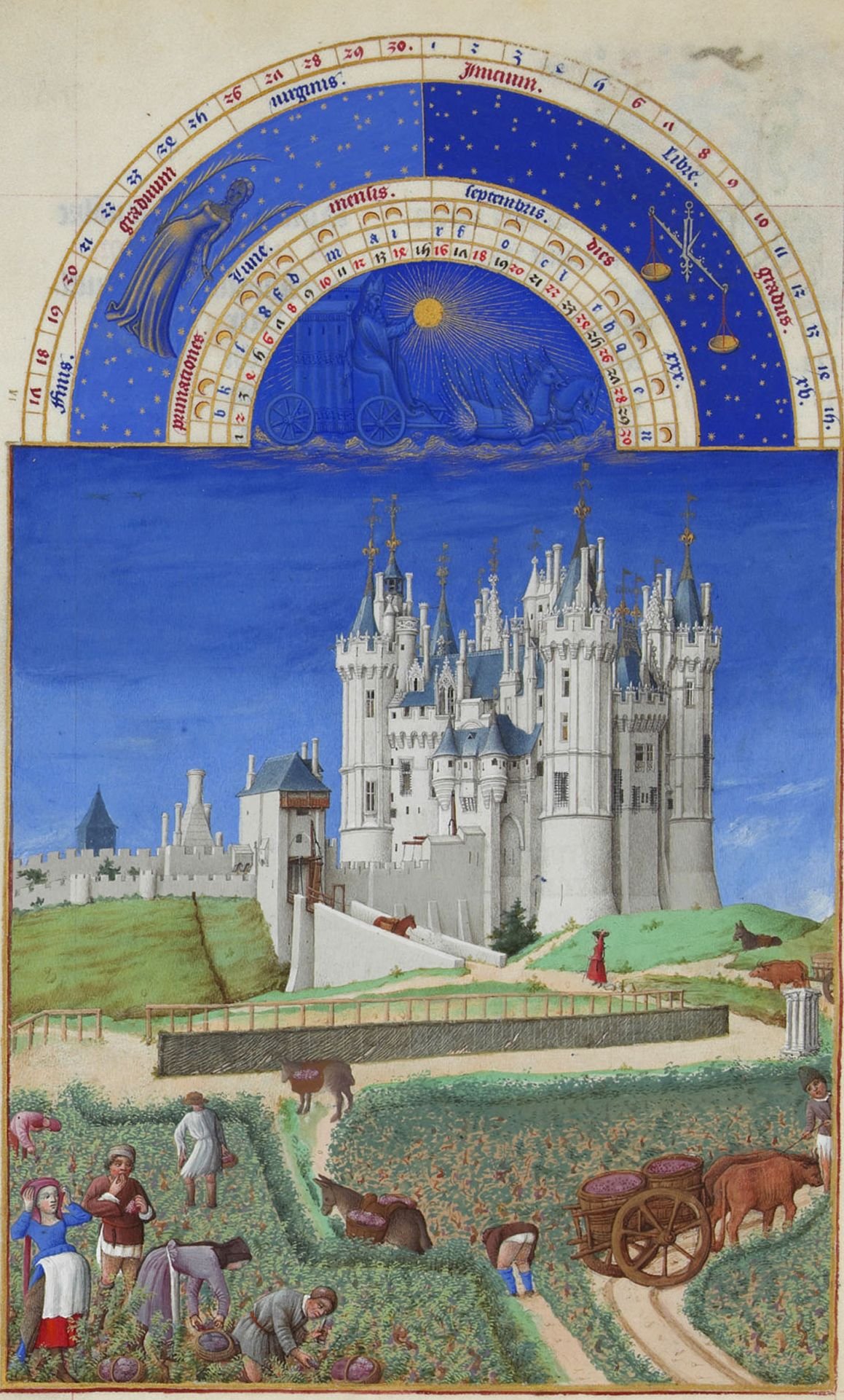
Image Credit: September from the Très riches heures du duc de Berry, (circa. 1440) Limbourg brothers, Public domain, via Wikimedia Commons
[1] https://dictionary.cambridge.org/dictionary/english/enjoy