

This week's post focuses on how to shorten verses and combine them into coherent stanzas, some vocabulary issues, a detour into the book of Job and an even bigger detour to answer the question, 'Are there volcanoes in the Holy Land?' It will take about five minutes to read, so if you just want the link to the psalm, scroll down to the bottom.
Once again, the Common Worship psalter numbers the verses of this week’s psalm differently from most Bibles. This version follows the CW numbering and begins at verse 26, which is usually verse 24.
The first half of verse 26 is quite long, so it took several drafts to condense it down to something manageable. My initial draft was, ‘O Lord, you have made so many things! You have made all of them wisely!’ I then shortened it to ‘O Lord, in your wisdom, you have made so many things!’ which worked better but was still too long. My third attempt was, ‘O Lord, you have made so many things wisely.’ This was certainly concise enough, but I wondered if that implied some things were not wisely made! In the end I went for, ‘O Lord, you have wisely made so many things.’ There is still a risk of misinterpretation here (was it wise to make lots of things rather than just a few?) but at this point I felt I was starting to overthink this and decided to leave it at that.
The second half of verse 26 is much shorter but still had a number of translation issues. Most translations use earth for ‘eretz’ here, as I did initially, but because the psalmist seems to be discussing land and sea separately, ‘land’ seems more appropriate.
At the end of the verse, I was going to use ‘creatures’ to translate the word ‘quinyan’, which the lexicons give as one possible translation, along with ‘acquisition’ or ‘thing purchased’ or ‘wealth’. Of these, ‘creatures’ seemed the best fit but I then ended up with too many ‘creatures’ in the stanza and it sounded too repetitive. I decided to survey how this word is translated in a range of English translations and found that quite a few have too many creatures! The Authorised Version uses ‘riches’, while some others use ‘possessions’ and the amplified Bible hedges its bets and has both! The New English Translation (NET) has ‘the living things you have made’, which I like but is rather long and Brenton’s English Septuagint has ‘the earth is filled with thy creation’. In the end, I chose, ‘the land is full of your creations’.
In verse 27 the sea is described as ‘great and wide’. The Hebrew word ‘yam’ refers to the Mediterranean (as well as any large body of water) and can also mean ‘westward’. As our world has bigger seas than the Med, it seems appropriate to use ‘ocean’ to give the sense of scale. The adjective ‘gadol’ (great) can also mean large, loud and intense as well as important; I thought ‘mighty ocean’ captured this idea concisely and rendered ‘wide’ superfluous.
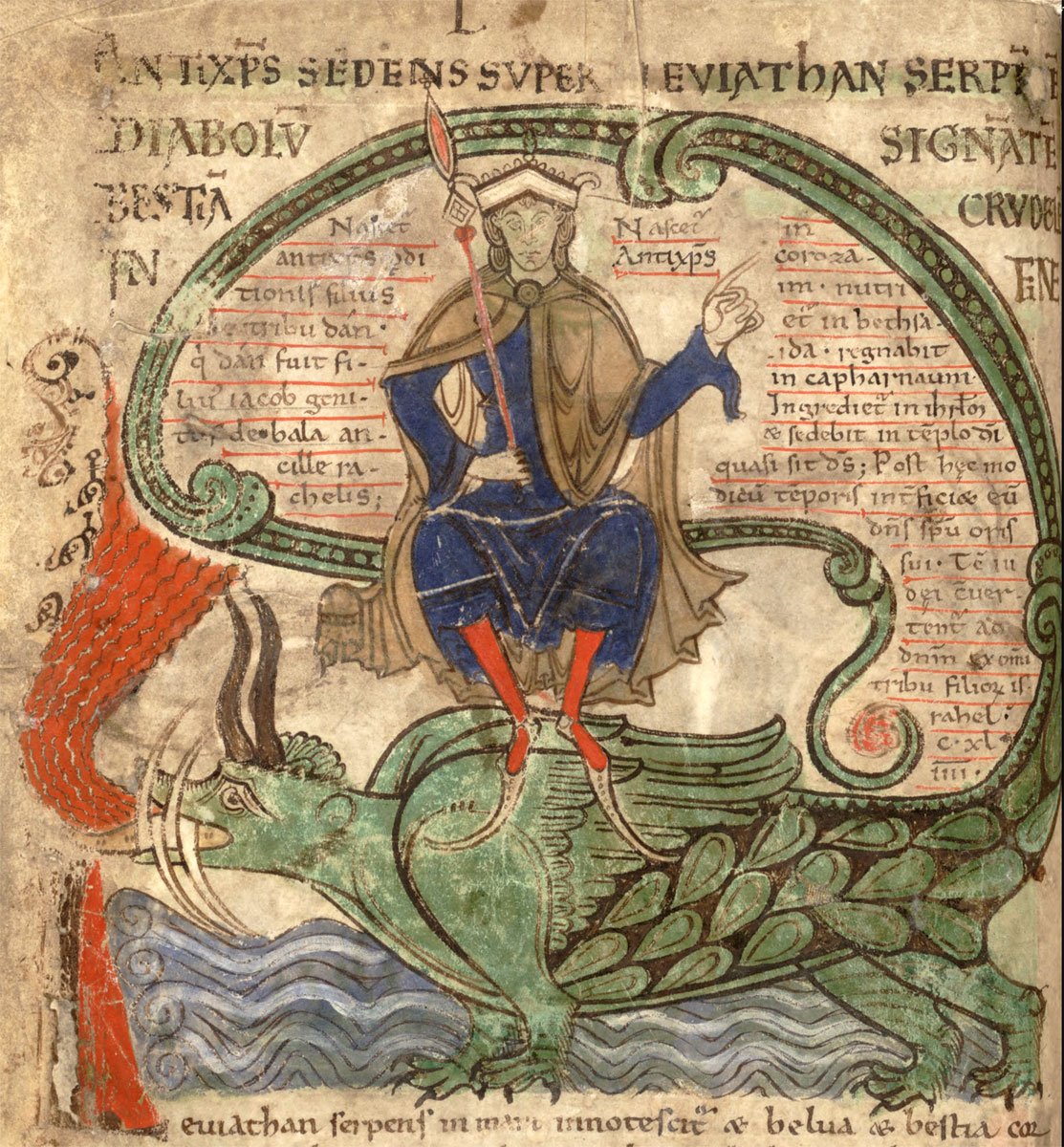
In verse 28 there is a reference to a sea monster. In most English translations the Hebrew is transliterated to give ‘Leviathan’. This creature is described in more detail in Job 41, where we learn that it can’t be fished with a hook and line (v1), is large enough to be divided between merchants (v6), and has skin too thick to be penetrated by harpoons or fishing spears (v7). It also appears to have scales (v 15 (NRSVue: ‘its back is made of shields in rows’ ) and to breathe fire (v18-21). Taking this into account, I decided to describe it as a ‘sea-dragon’.
It took some jiggling to get verses 26-28 into a single stanza. I felt it was particularly important to keep verses 27 and 28 together as they are all about the sea, which is not explicitly stated in verse 28 (I tried restating it, but that wound up with lines that were too long). In the end, I decided to put the second half of verse 26 and the first half of verse 27 into a single line contrasting the land and ocean.
26 O Lord, you have wisely made so many things!
The land is full of your creations, 27as is the mighty ocean.
Countless creatures swim there, both large and small;
28 there ships sail, and there plays the sea dragon you made.
I began the next stanza (verse 29) by restating the referent (all your creatures) rather than using ‘they’ as in the Hebrew and balanced the length of the verse by replacing, ‘They wait for you to give them food’ with ‘All your creatures wait for your to feed them’. The verse continues by describing when God feeds the creatures. Many translations use ‘in due season’, which is not natural in modern English, so I wanted to find an alternative. I considered ‘at the proper time’ (which is used in the New International Version) but in the end I went with ‘when they need it’, which is similar to the New Living Translation’s ‘give them food as they need it’.
In verse 30 I swapped the word order from the literal ‘you give them and they gather it’ to ‘you gather what you give them’, which flows better in English and also provides better coherence with the next line.
29 All your creatures wait for you
to feed them when they need it.
30 They gather what you give them,
you open your hand and they are filled with good things.
In the next stanza, I added ‘when’ at the beginning of verse 31 to make it sound more natural in English (a few other translations also do this). As for what the creatures do, the lexicons translate the Hebrew ‘bahal’ as ‘are afraid’, ‘tremble in fear’, ‘are alarmed’, ‘are agitated’ or ‘are dismayed. Lots of translations use ‘dismayed’ but this seems weak. Some use ‘terrified’ or ‘troubled’ and a few use ‘panic’ (NLT, NET) which I think works well.
In verse 32, most translations use ‘face of the earth’ but I think ‘surface of the earth’ is clearer.
31 When you hide your face your creatures panic,
When you take away their breath, they die and return to dust.
32 When you send out your spirit they are created,
and you renew the surface of the earth.
The next two verses were quite straightforward to translate, but I fell down a bit of a rabbit hole with ‘God strikes mountains and they smoke’ as I wondered what it really referred to in context. My first thought was that it could be alluding to volcanoes but, as far as I was aware, there aren’t any in the Holy Land. However, according to a book published by Charles Daubeny in 1848, there may have been volcanoes in Syria, the Holy Land and Arabia in the time of the prophets.[1] Or it could just be storm clouds gathering over mountains.
33 May the glory of the Lord last for ever!
May the Lord rejoice in all God has made!
34 The Lord looks at the earth and it quakes,
God strikes the mountains and they smoke.
In verse 35, most translations have the psalmist making music ‘while I have my being’, which sounds strange. A few have ‘while I exist’ or ‘as long as I live’ (when they don’t use that in the previous line). The Hebrew word has a sense of ‘again and again’ or continuation, so I have chosen to use ‘continually’.
My interpretation of the first line of verse 36 is that the psalmist will find thinking about God pleasurable. I think this is supported by the second line which parallels it with ‘I will be glad in the Lord. However, lots of translations have the psalmists meditation being pleasing to God.
35 I will sing to the Lord all my life.
I will make music to my God continually.
36 My contemplation of the Lord shall be sweet.
I will rejoice in the Lord.
I considered setting the first line of verse 37 (which is optional in the lectionary) but decided it was better to omit it and use verse 37b as the refrain.
Click the following link for the music for Psalm 104 for Pentecost.
I have now started adding psalms for the related readings track (propers 5 – 8 so far) so if you’re planning music for the next couple of months do take a look. And you can click here for the psalm for Trinity Sunday.
Image: The Antichrist seated on the Leviathan from Lambert’s Liber Floridus (1120), Ghent University. Public domain, via Wikimedia Commons
[1] Charles Daubeny, A Description of Active and Extinct Volcanoes, of Earthquakes, and of Thermal Springs, (Cambridge University Press, 1848, reprinted 2011). Accessed online on 22nd May 2026 at https://doi.org/10.1017/CBO9780511978159.022