

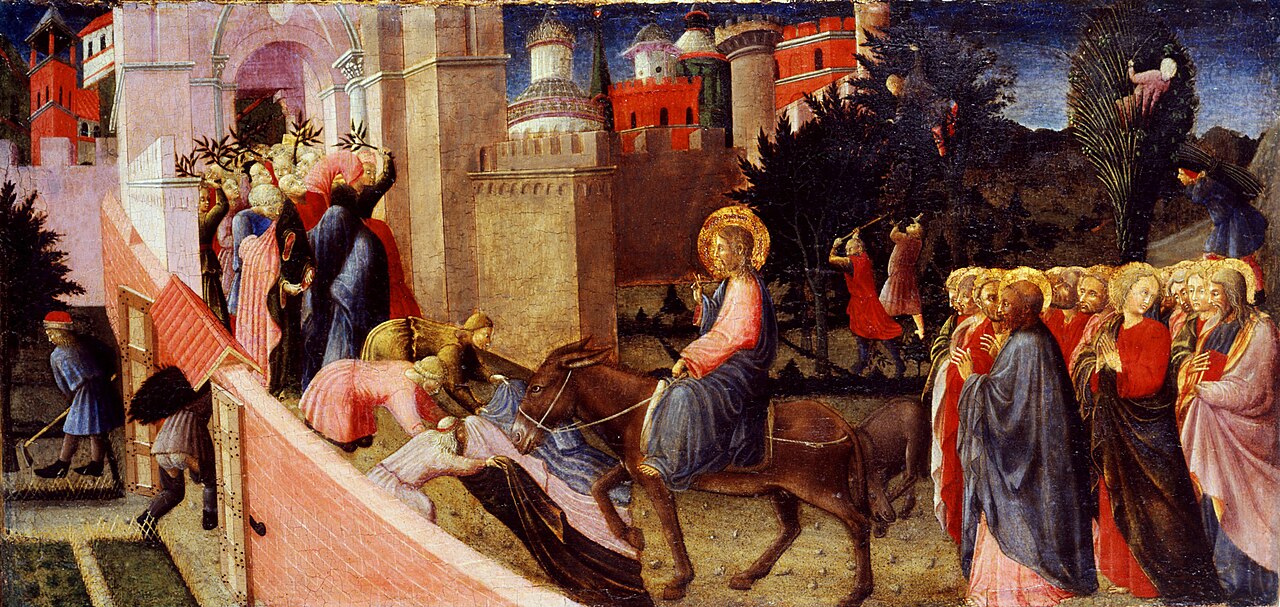
Palm Sunday is unusual in having two psalms set for the Principal Service along with two Gospel readings. Local traditions vary, but in our Church we have the main Liturgy of the Palms outside with a smaller gathering of those of us unable to do the Palm Sunday Procession following the same liturgy in church. Then, we have the Liturgy of the Passion in church. We have neither psalm as we try to save time to allow for a lengthy dramatized passion reading.
So, with nothing to prepare for use in our church, I had free rein to decide what to do for Psaltery and Harp. As Psalm 118 is set for Easter Day as well as the Liturgy of the Palms, I have decided to tackle this translation first. Next year I will set the psalm for the Liturgy of the Passion.
There is a choice of verses from Psalm 118 set for Palm Sunday, either verses 1-2 and 19-29 or 19 – 24. I have decided to go with the shorter option. This is partly due to the time pressures on Palm Sunday, and partly because I think verse 19 ‘Open the gates’ is a strong place to start as it clearly ties in with a procession through the gates of Jerusalem to the Temple (or through the lych gate and into church). It also seemed appropriate to write a refrain that uses the crowd’s cry of ‘Hosanna’ and incorporate its translation: ‘Hosanna, hosanna, hosanna! The Lord has come to save us!’
In my translation of the first two verses, I decided to avoid using ‘righteousness’. You may have notice that I tend to do this as a matter of course. I have two reasons for this:
Firstly, I don’t think ‘righteousness’ is an easily understood concept. In everyday English, it is mainly used in the phrase ‘self-righteous(ness)’. This means that the connotations of selfishness and ‘holier-than-thou-ness’ are what is most likely to spring to mind, rather than the positive meaning it is supposed to have.
Secondly, ‘righteousness’ is not the easiest word to decide quickly how to sing. Should you go for the slightly ugly three-syllables of, ‘rye-CHUS-ness’ or the more archaic four-syllable ‘RYE-tee-us-ness’? On the whole I think it is better to choose a different word, and I have gone for ‘justice’.
Having dispensed with ‘righteousness’ in verse 19, I also decided not to have ‘the righteous’ entering through the gate of the Lord in verse 20. Most English translations do use ‘righteous’ here, although some have ‘the godly’ (which is fine, but not exactly normal parlance). The Hebrew word is given in the lexicons as ‘just, righteous, right, lawful’. I didn’t feel that any of those quite worked for my purposes, so I decided to look for English synonyms for ‘righteous’ to see if I could find something more suitable.
The Merriam Webster online dictionary defines ‘righteous’ as ‘acting in accordance with divine or moral law: free from guilt or sin’ (incidentally, you might want to try their little quiz on the meaning of ‘righteous’). Working from this definition, I decided to use ‘guiltless’ because I felt it would be an appropriate way to allude to Jesus entering Jerusalem.
19 Open the gates of justice for me
and I will enter to praise the Lord.
20 This is the gate of the Lord,
through which the guiltless enter.
The next stanza was quite straight forward:
21 I praise you, Lord, for you have heard me
and have become my salvation.
22 The stone the builders rejected
has become the corner stone.
Verse 23 literally starts, ‘The Lord has done this’ but as it comes at the beginning of a stanza, I needed to make the ‘this’ explicit. ‘This’ clearly refers back to what the Lord did in the previous stanza, which is to have ‘become my salvation.’ However, because the next line is in the first person plural (‘we will rejoice’) I have used ‘The Lord has become our salvation’ to match.
The rest of verse 23 says that this thing is ‘wonderful/amazing/marvellous in our eyes’. After much thought I decided to lose the ‘in our eyes’ as it seems clunky at the end of the line. I also thought it would be hard to ensure the right emphasis at the beginning of the line. In deciding what descriptor to use, I felt that ‘marvellous’ had too many syllables and ‘wonderful’ seemed a bit too weak, so I went with ‘amazing’ adding ‘thing to see’ to give a satisfying rhythm to the line as well as being in plain English.
Verse 24 is the famous line ‘This is the day that the Lord has made, we will rejoice and be glad in it.’ This is so well-known that I was tempted to quote it almost directly, removing only the superfluous ‘that’. However, when I came to point it, I decided that ‘We will rejoice in it and be glad’ would be easier to sing.
23 The Lord has become our salvation,
an amazing thing to see!
24 This is the day the Lord has made,
We will rejoice in it and be glad.
Click through for the full text and music to Psalm 118 for Palm Sunday. Everything is still available on a 'pay what you think it is worth' basis.