

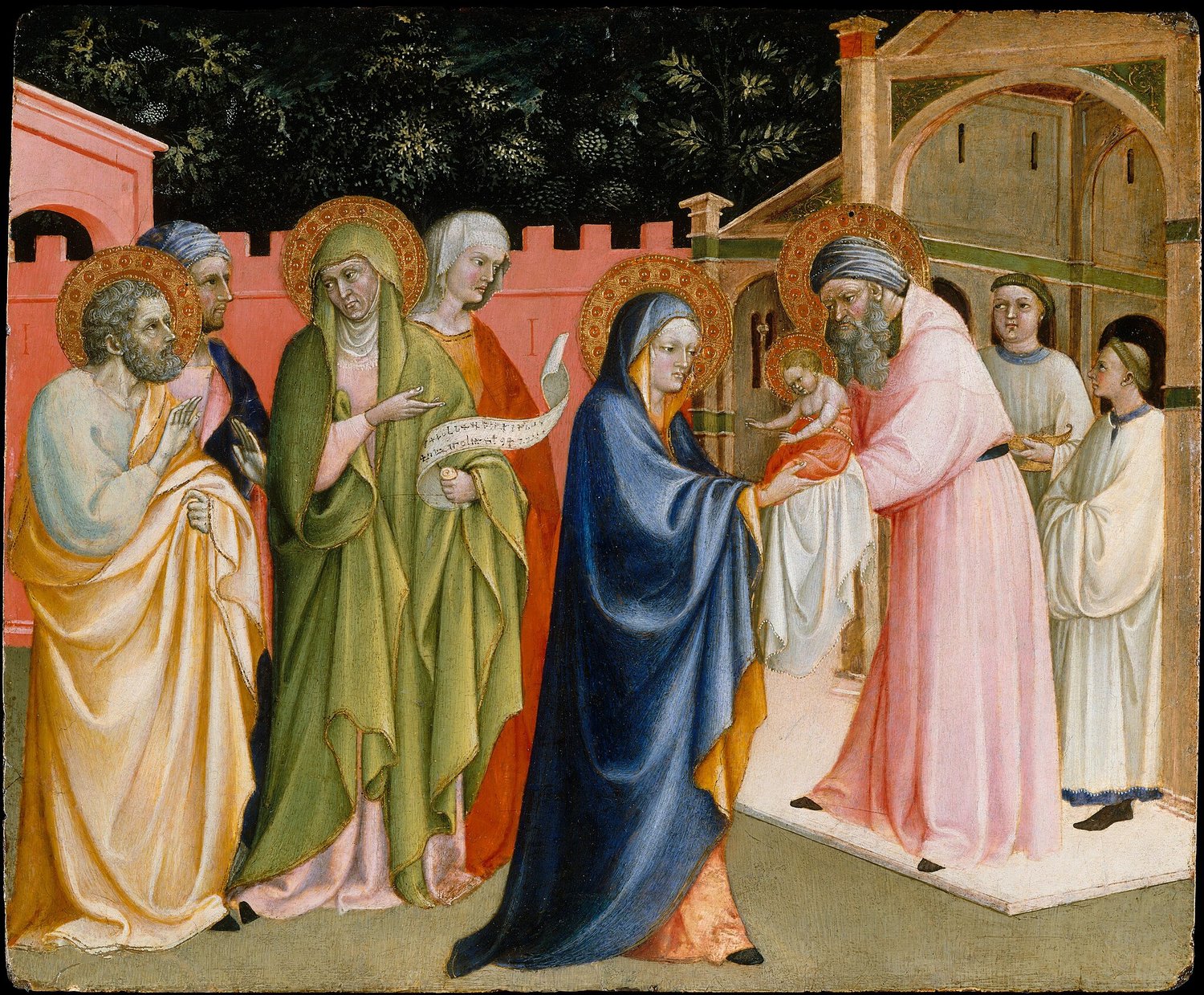
Today’s blog is going to focus on the psalm set for the Presentation of Christ in the Temple, commonly known as Candlemas. Apologies to anyone keeping Epiphany 4 this Sunday (click through for the music and text for Psalm 36 if you need it).
For Candlemas, the lectionary offers two selections of verses of psalm 24. I have decided to go for the shorter option, setting only verses 7 – 10.
There are two reasons for this:
Firstly, this part of the psalm includes the reason it is set for the Presentation of Christ in the Temple as it calls on the temple gates to welcome God in.
And secondly, unlike the first part of the psalm, these verses each have three lines, which means they can be neatly set as single verse stanzas to a three section chant.
Verses 7 and 9 of this psalm are identical and begin with the striking – if a little strange – image of gates lifting their heads. In the LXX, the word for ‘heads’ means rulers, princes, chiefs or leaders. The Hebrew could also have this meaning, as well as a literal head, top or tip. The French Louis Segond Bible (which uses the same word for doors and gates) has ‘Portes, elevez vos linteaux’ - Doors, raise your lintels.
While the interpretation of the gates being exhorted to raise up their ruler is an interesting one, I have decided, to retain ‘heads’ in the first line as this is a very familiar text. The idea of gates lifting up heads could be a metaphor for being alert and watchful or maybe for having pride in God. Some translations use ‘rise up’ or ‘look up’ and the NLT has ‘open up’.
The second line, ‘Let the eternal doors be lifted up’, is also interesting. Many translations have ‘everlasting doors’, while a number have ‘ancient doors’. I have chosen to use ‘eternal’ (like the NET) to evoke the idea of eternal as both extending from the past into the future (and alto reduce the number of syllables).
Even more interesting, however, is the verb, as the Hebrew word for ‘lifted up’ appears in a different tense than it did in the first line. This time it is in the passive voice. As well as to ‘be lifted up’ it can also mean to ‘be taken away’, ‘carried off’ or ‘swept away’.[1] I quite like the idea of gates being ‘carried off’ or ‘swept away’ as it suggests them being flung open, but I eventually decided to stick with the more conventional ‘be lifted up’ to create a symmetrical structure in the first two lines.
Having retained the traditional ‘lift up your heads’ I decided to do something different, replacing the usual ‘king of glory’ with an adjective to describe the king. The NET goes for ‘majestic king’ but I have chosen to use ‘glorious’ so that it doesn’t depart too drastically from the traditional translation. This description is also used in verses 8 and 10.
7 Lift up your heads, O gates!
Let the eternal doors be lifted up,
so the glorious king may come in.
8 Who is this glorious king?
The Lord, strong and mighty.
The Lord, mighty in battle.
In verse 10 the glorious king is revealed as being the ‘Lord of hosts’. Here, the LXX differs from the Hebrew as it has ‘the Lord of power’ or ‘the Lord of armies’ (Brenton). The Hebrew word here translated as ‘hosts’ could also mean an army, but alternatively, it could be a host of angels. I have decided to retain the ambiguity and stick with the common translation of ‘hosts’.
10 Who is this glorious king?
The Lord of hosts;
God is the glorious king.
Although I haven’t attempted to translate it, the Hebrew text ends with the word ‘selah’. This is believed to be a musical term, which Strong defines as ‘suspension (of music). The Brown-Driver-Briggs Lexicon says St Jerome classed it with ‘Amen’ or ‘Shalom’ as an ending. Most liturgical translations simply omit it!
This time, the refrain is not taken directly from the psalm but draws on verse 7 to encourage the congregation to praise God. Click through for the full text and music for the Candlemas Psalm.
[1] See the Outline of Biblical Usage and extract from the Brown-Driver-Briggs Lexicon here: https://www.blueletterbible.org/lexicon/h5375/lxx/wlc/0-1/. Note that the translation ‘swept away’ here refers to a multitude of people (Dan 11.12)