

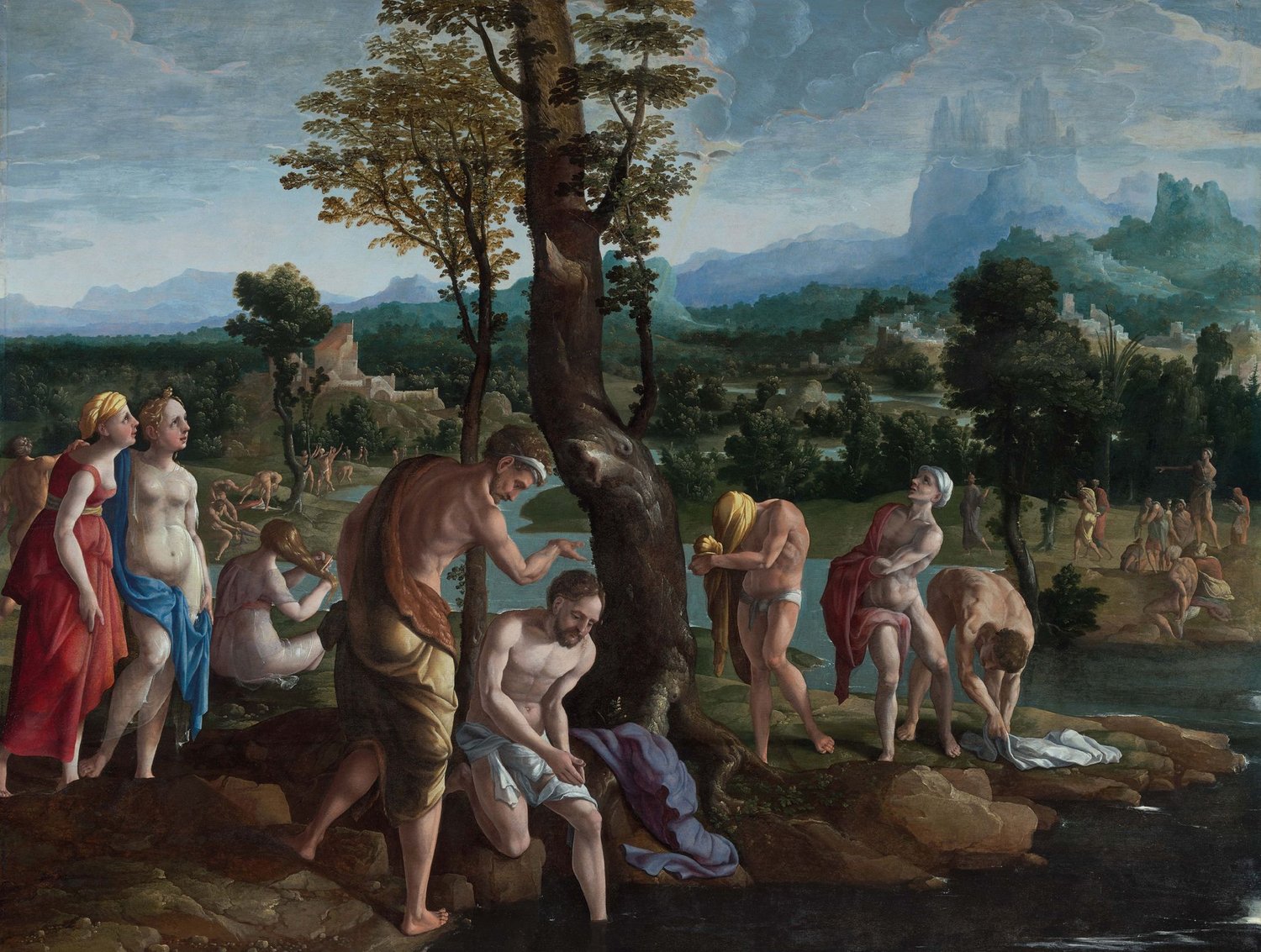
Coming hard on the heels of the feast of the Epiphany, and therefore skipping about thirty years of Jesus’s life, I always feel that the Baptism of Christ comes rather too soon! Especially if you kept Epiphany on Tuesday. In which case Sunday-only churchgoers will have moved even more abruptly from Christmas to Baptism.
But we are where we are and I think this psalm helps to bridge the gap a little, having perhaps inspired an Epiphany hymn as well as giving us an opportunity to reflect on the voice of God heard at Christ’s baptism.
Now, on with the translation notes.
The opening of this psalm is rendered in quite different ways in English translations, with a big difference between those following the Greek Septuagint (LXX) and those following the Masoretic (Hebrew) text.
Brenton’s English Septuagint gives the heading ‘on the occasion of the solemn assembly of the Tabernacle’ and verse one reflects this ascription, continuing, ‘Bring to the Lord, ye sons of God, bring to the Lord young rams; bring to the Lord glory and honour.’ It is this interpretation that is found in the Coverdale (BCP) psalter.
In the Common Worship version, verse one reads, ‘Ascribe to the Lord, you powers of heaven, ascribe to the Lord glory and strength.’ In a number of other translations, rather than powers of heaven ascribing things to God, there are ‘heavenly beings’, ‘sons of the mighty’ or ‘mighty ones’ giving to God, which begs the questions ‘giving what?’
As ‘ascribe’ is not a common word in English, I have decided to follow the Septuagint’s idea of the psalm being connected to the building of the temple by interpreting the command ‘give to God’ as ‘make an offering’ and opening the psalm with those words.
Many translations interpret the end of verse 2 as an instruction to worshippers to ‘wear holy attire’, while the LXX has the instruction to worship the Lord in his holy court. The Authorised Version has ‘worship the Lord in the beauty of holiness’, which I have chosen to retain as it evokes the Epiphany hymn by John Samuel Bewley Monsell (1811 – 1875).
1 Make an offering to the Lord all you people,
Give God honour and praise.
2 Give God the glory due to his name.
Worship the Lord in the beauty of holiness.
In verse 3 we see why this psalm is set for the Baptism of Christ. The voice of God is described as being 'above' or 'over' the waters.
I have chosen to use ‘over’ in the first line of the stanza to recall the beginning of Genesis where the Spirit of God hovers over the waters at creation. This reflects the theology of the waters of baptism making a new creation.
In the next line, however, I have used ‘above’ to turn the attention upwards to the voice of God coming down from heaven at Christ’s baptism. Of course, this line is also a reference to ancient cosmology which viewed the blue sky as being water and placed God above the waters of the heavens.
3 The voice of the Lord is over the waters
The Glory of God thunders above great waters.
4 The voice of the Lord is powerful,
The voice of the Lord is glorious.
In verse 5, the reference to the cedars of Lebanon not only demonstrates God’s power, but once again alludes to Solomon’s temple, which is described in Kings and Chronicles as being built with cedar wood from Lebanon.
5 The voice of the Lord breaks the cedar trees
The Lord breaks the cedars of Lebanon.
6 God makes Lebanon frisk like a calf
and Sirion leap like a young wild ox.
Imagery evoking the temple and it’s burnt offerings continues in verse 7 with the voice of the Lord splitting the flaming fire, while in verse 8 the stripping of forests not only evokes the dramatic power of God in nature, but also the provision of wood for the temple. This is made explicit in the last line of the stanza.
7 The voice of the Lord splits the flaming fire.
The voice of the Lord shakes the wilderness of Kadesh.
8The voice of the Lord makes deer give birth and strips the forests bare.
In his temple, everything tells of his splendour.
The final stanza dials the drama back down, returning to the image of God sitting as King above the waters of the heavens and giving strength and peace to his people.
10 The Lord sits above the waters
The Lord sits as King for ever.
11 The Lord gives strength to his people
The Lord blesses his people with peace.
The music for this psalm can be found in the shop: Psalm 29.