

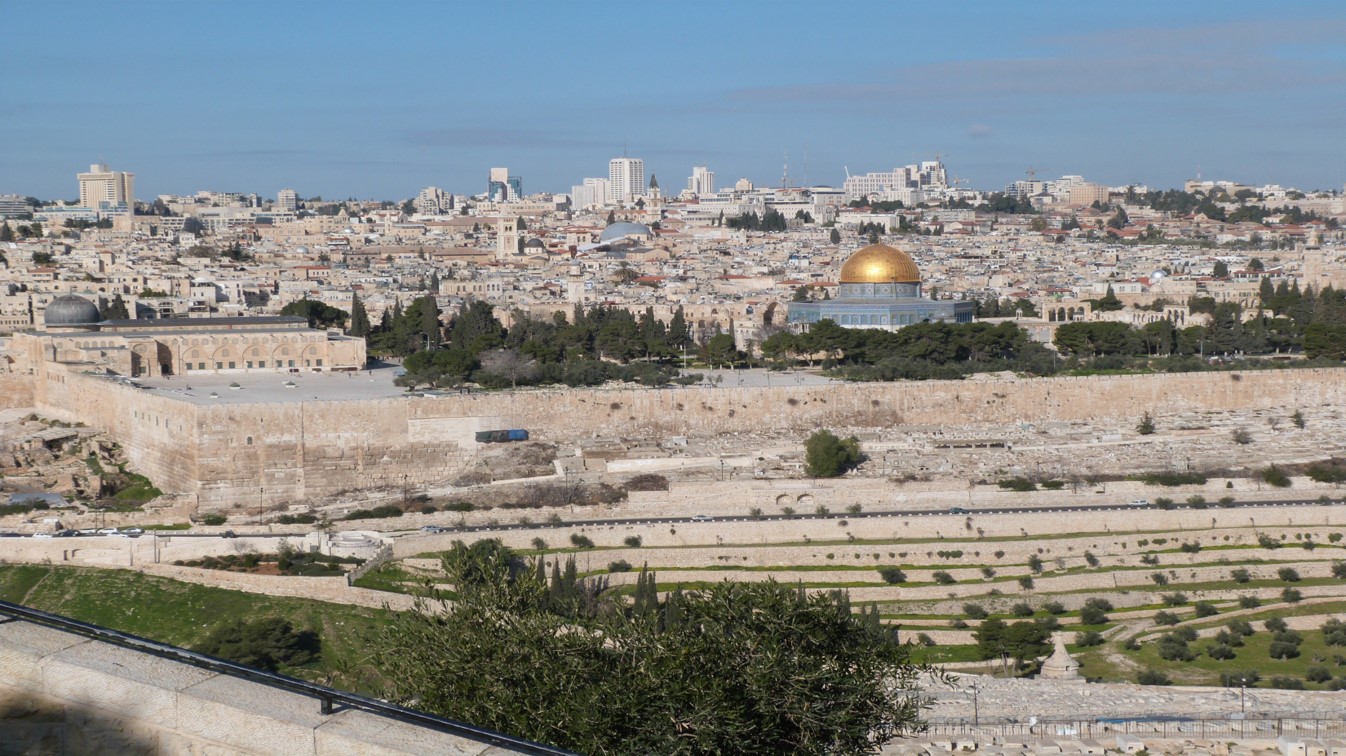
Psalm 122 is one of fifteen psalms (120 – 134) prefaced by the words ‘Song of Ascents’.
There are several theories as to what this means, but it seems most likely that they were traditionally sung by Jewish pilgrims visiting Jerusalem for the three pilgrimage feasts of Passover, Shavuot and Sukkot. These three festivals celebrated the harvests of barley, wheat and fruit respectively, the first two taking place six weeks apart in early summer and the last towards the end of the dry summer season.
In my translation, I have chosen to highlight Jerusalem’s role as a place for all of the Lord’s people. This includes congregations using the psalm in their worship today, so in verse 2 I use the present tense to help the congregation imagine that they too are in the Holy City.
1 I was glad when they said to me,
‘Let us go to the house of the Lord!’
2 And now we stand within your gates, O Jerusalem!
Verse 3 describes an important characteristic of Jerusalem, but in many English translations it is unclear what this characteristic may be. Word for word translations use phrases such as 'Jerusalem – built as a city that is bound firmly together' (NRSVue) or ‘Jerusalem is built like a city that is closely compacted together.’ (NIV) but in my view, these translations lack coherence with the next verse, which mentions the tribes of Israel. The Coverdale translation of the psalms, which is used in the Book of Common Prayer, has, ‘Jerusalem, built as a city that is at unity in itself. Thither the tribes go up, the tribes of the Lord.” This establishes a contrast between the unity of the city and the diversity of the tribes. It is this meaning that I have drawn out in my translation.
In verse 4, I have also changed the syntax to avoid separating the subject and verb, so that the English text flows more naturally. In my view, moving the clause rendered by the NRSVue as, ‘as was decreed for Israel’ from the middle to the end of the verse results in greater coherence between the tribes and what they do (‘go up to praise God’). It also brings the references to ‘law’ and ‘judgement’ closer together, linking verses 4 and 5 together more clearly.
3 Jerusalem is built as a united city
4 where the tribes of Israel, the Lord’s people,
go up to praise God as their law requires.
5 For there sit the thrones of judgement,
the thrones of the house of David.
I have taken verse 6 out of the body of the psalm to use as the refrain. In this verse, I have chosen to use ‘flourish’, rather than the more common ‘prosper’, mainly because it expands the meaning away from the financial connotations of ‘prosperity’ and looks towards a wider sense of health, growth and wellbeing. It is also easier to sing!
6 O pray for the peace of Jerusalem,
that all who love her may flourish.
The final stanza expands on this theme of peace and abundance as a source of wellbeing for all. To make the text as inclusive as possible, I have chosen to use ‘family and companions’, rather than the more literal ‘brothers and friends’. I particularly wanted to get away from the idea that you have to be related to, or friendly with, people to care about their wellbeing. This also subtly alludes to the pilgrim context familiar from the hymn line ‘We are pilgrims on a journey, and companions on the road’ (Brother, sister, let me serve you by Richard A.M. Gillard).
7 O Jerusalem, may peace be within your walls,
and abundance with-in your citadel!
8 For the sake of my family and companions, I say,
‘May peace be within you!’
9 For the sake of the house of the Lord, I will seek your good.
The sheet music for Psalm 122 is now available in the shop.