

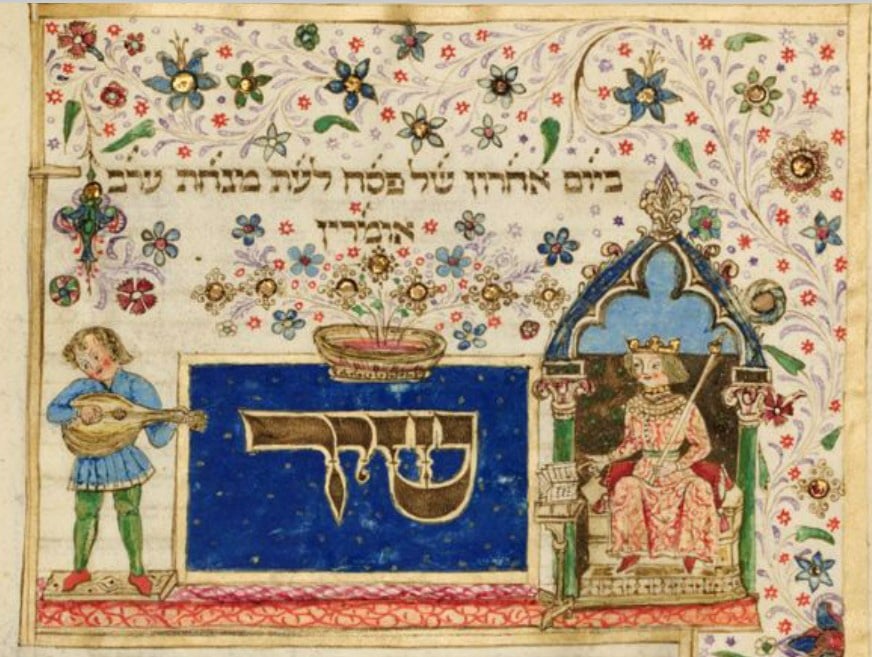
Psalm 72 is headed ‘A Psalm of Solomon’ and is a prayer for the king and his heir.
This could be a dedication: a prayer for King Solomon. This is Robert Alter’s view. He states in his commentary on the Psalms, ‘The editorial linkage with Solomon … no doubt reflects the tradition regarding the imperial grandeur of the Solomonic reign.’ But if so, the psalmist’s prayer was not granted, as Solomon’s heir, Rehoboam, did not display wise judgement, resulting in the division of the kingdom. It therefore seems more likely to me that Solomon himself was the author, praying for his father, King David, and himself. Alter, however, quotes a medieval Rabbi, David Kimchi (1160 – 1235, his surname is also spelled Kimhi), who believed the psalm was composed by David about his son. As Alter notes, this idea is encouraged by the editorial post-script to the psalm (verse 20, which is usually omitted in liturgical translations) which he translates as ‘The prayers of David son of Jesse are ended’.[1]
In Christian tradition, however, the figure of the king often represents Jesus – the eternal king – hence its use here in Advent (and also at the feast of the Epiphany).
The first stanza begins with the petition for the king and his son. I have smoothed out the English syntax in verse 1 so that it leads more naturally into verse 2. While the Hebrew uses a singular pronoun (‘he’) is verse 2 I have taken the liberty of using the plural as the prayer is on behalf of both the king and his son. Verse 3 speaks of mountains and hills bringing peace to the people. This is an allusion to Jerusalem as the royal city from which the king rules.
1 O God, grant the king your judgement, and his son your righteousness.
2 So they may judge your people fairly, and your poor with justice.
3 The mountains will bring peace to the people,
and the hills will bring righteousness.
The second stanza speaks of the king’s defence of the oppressed. Many translations use the construction ‘May he…’ but like a number of other translations, I have chosen to use the future tense here to make it more relevant for a modern congregation. In verse 5, I have avoided using the word ‘fear’ as, for me, it makes no sense to fear a loving God. I think ‘revere’ expresses a proper attitude to God’s righteousness far better for a modern audience. I have also moved the reference to generations into the first half of the verse to avoid splitting the sense of the English sentence with the reference to the sun and moon.
4 The king will defend the poor and rescue the children of the needy,
bringing down their oppressors.
5 Your people will revere you for generations –
as long as sun and moon endure.
Stanza three continues with images of God’s bounty in sending rain to a Mediterranean country that no doubt appreciates it more than we do in Britain! Most translations have the rain falling on mown grass, although interestingly, a few follow the Septuagint in having the rain fall on a fleece. At the beginning of verse 7, I have used ‘in those days’ rather than, ‘in his days’ (i.e. during the king’s reign) as the context within the stanza makes it clear that this is referring to the time when God will descend to earth.
6 God will descend like rain on mown grass,
like showers that pour down upon the earth.
7 In those days, the righteous will flourish,
and peace will abound until the moon is no more.
The final stanza (which may be omitted on Advent 2) comprises verses 18 and 19 and acts as a doxology (albeit not a Trinitarian one). The refrain is taken from part of verse 19, with an added Alleluia.
18 Praise the Lord, the God of Israel,
who alone does wondrous things.
19 Bless God’s glorious name for ever;
the whole world is filled with God’s glory. Amen and amen.
[1] Robert Alter, The Hebrew Bible: Volume 3 The Writings, p.173 - 175